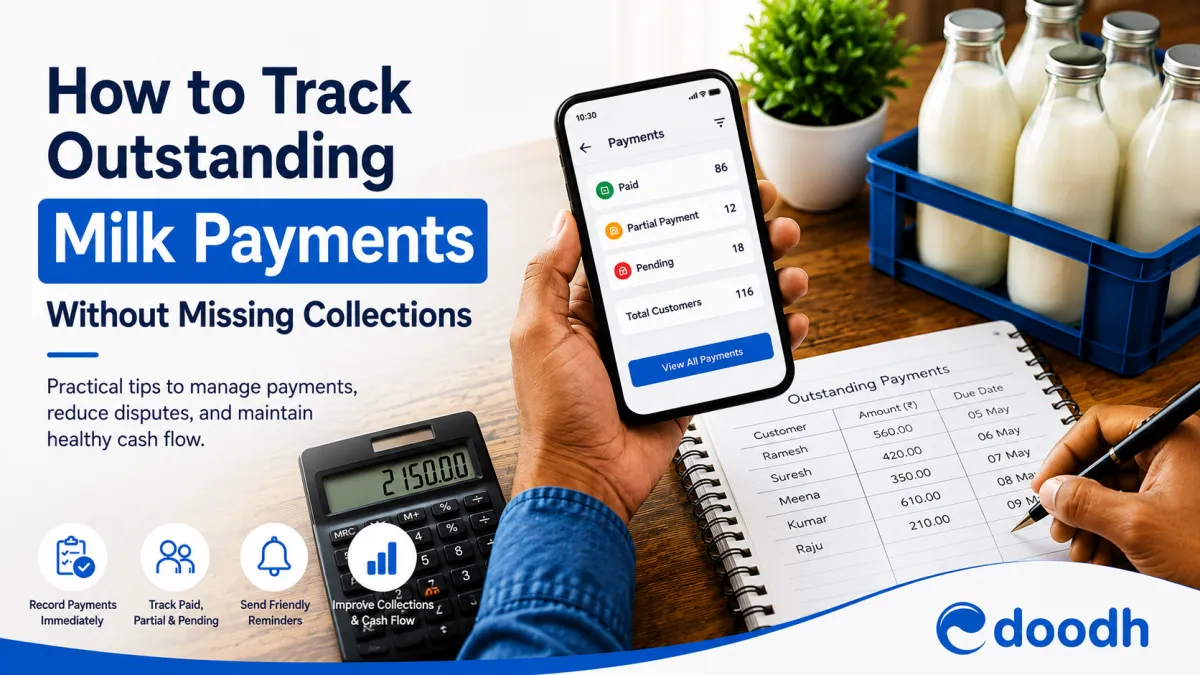
Tracking outstanding milk payments becomes easier when you record payments promptly, review pending balances regularly, and maintain accurate customer records. These practical tips help dairy vendors improve collections, reduce payment disputes, and maintain healthy cash flow.
It's the 5th of the Month...
Most of your customers have already paid.
A few haven't.
One customer says, 'I'll send the UPI payment this evening.'
Another tells you, 'Please adjust it with tomorrow's delivery.'
One customer has paid only part of the bill.
Another insists they already paid last week.
You open your notebook to verify the payments.
Then you search through WhatsApp messages.
Finally, you open your Excel spreadsheet.
Twenty minutes later, you're still trying to figure out who has actually paid and who still has an outstanding balance.
If this sounds familiar, you're not alone.
Many dairy vendors don't struggle because customers refuse to pay. They struggle because payment records aren't updated consistently throughout the month.
As your customer base grows, even a few missed payment entries can lead to billing confusion, delayed collections, and unnecessary payment disputes.
The good news is that outstanding milk payments are much easier to manage when you follow a simple process consistently.
In this guide, you'll learn practical techniques to keep payment records organised, improve collections, reduce disputes, and maintain healthy cash flow.
Why Outstanding Payments Become Difficult to Manage
Outstanding payments rarely become a problem overnight.
They usually build up because of several small mistakes repeated over time.
- Payments are received but not recorded immediately.
- Cash and UPI payments are maintained in different places.
- Partial payments are forgotten.
- Customers ask to pay later, but no reminder is recorded.
- Payment records are spread across notebooks, WhatsApp chats, and Excel sheets.
Each of these situations may seem minor on its own. However, when they happen repeatedly, they make month-end collections far more difficult than they need to be.
The goal isn't just to collect payments. It's to maintain accurate customer payment records every day so that collections become predictable, professional, and stress-free.
1. Record Payments Immediately
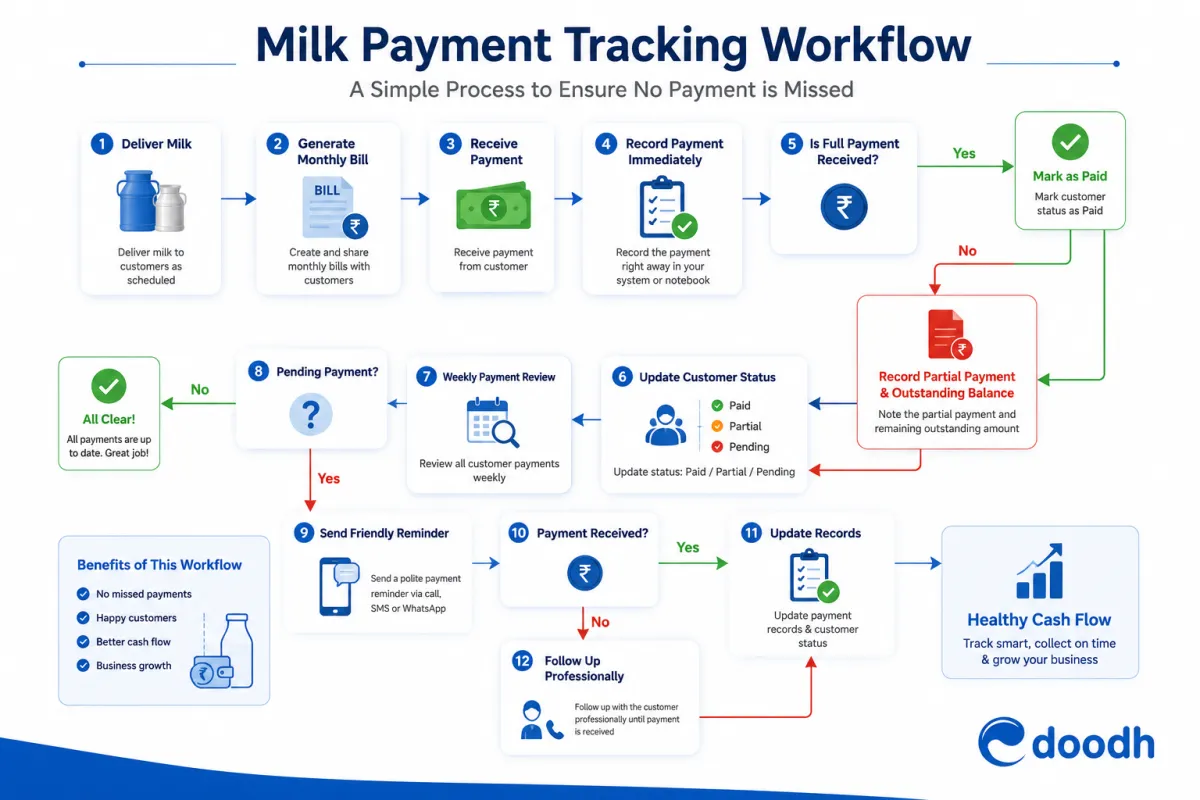
One of the simplest ways to avoid payment confusion is to record every payment as soon as you receive it.
Waiting until the evening or the end of the week increases the chances of forgetting small transactions.
Example
While delivering milk, one of your customers pays you through UPI.
You think, 'I'll update it after I finish today's deliveries.'
By evening, you've completed dozens of deliveries, answered customer calls, handled vacation requests, and spoken to new subscribers.
Now you can't remember whether that payment was already recorded.
Why This Happens
Milk delivery businesses receive payments in different ways throughout the day.
- Cash
- UPI
- Bank transfer
- Family member payments
Without a habit of updating records immediately, it's easy for transactions to be missed.
What You Can Do
Make payment recording part of receiving the payment itself.
Whether you maintain records in a notebook, Excel spreadsheet, or milk delivery management software, update the customer's payment status immediately.
Expert Insight
Many payment disputes happen because records are updated later instead of when the payment is actually received.
Quick Tip
Spend one minute recording every payment before moving on to your next delivery.
Common Mistake
Depending on memory to update payments at the end of the day.
Best Practice
Treat payment recording as part of your collection process, not as a separate administrative task.
2. Separate Paid and Pending Customers
As your customer list grows, simply maintaining payment records isn't enough.
You should also be able to identify who has already paid, who has partially paid, and who still has outstanding dues within a few seconds.
Example
You decide to send payment reminders to customers with pending balances.
Instead of seeing a clear list, you spend twenty minutes checking individual payment entries one by one.
Meanwhile, one customer who paid yesterday accidentally receives a reminder message.
Situations like these create confusion and may reduce customer confidence.
Why This Happens
Many vendors keep one long payment register without clearly indicating payment status.
As the number of customers increases, finding pending accounts becomes increasingly difficult.
What You Can Do
Maintain three simple payment categories for every customer.
- Paid
- Partial Payment
- Pending
This allows you to review outstanding payments quickly without checking every transaction individually.
Expert Insight
Clear payment status is just as important as recording payment amounts. It saves time and improves collection efficiency.
Quick Tip
At the end of each day, spend five minutes updating customer payment status before closing your records.
Common Mistake
Sending reminders without verifying the latest payment updates.
Best Practice
Review payment status regularly instead of waiting until the next billing cycle.
3. Send Friendly Payment Reminders
Following up on pending payments doesn't have to feel uncomfortable.
In many cases, customers don't intentionally delay payments. They simply forget because of their own daily commitments.
A polite reminder sent at the right time is usually enough to receive the payment without affecting your relationship with the customer.
Example
It's the third day after your monthly billing cycle.
One of your regular customers hasn't made the payment yet.
Instead of waiting until the outstanding amount grows larger, you send a simple WhatsApp message.
Hello! This is a friendly reminder that your milk payment is pending. Please make the payment whenever convenient. Thank you.
Within a few minutes, the customer apologises, completes the payment, and thanks you for the reminder.
Why This Happens
Customers are busy with work, family responsibilities, travel, and personal commitments.
Missing a payment date doesn't always mean they are avoiding payment.
What You Can Do
Create a simple reminder schedule.
- Send the first reminder two or three days after the due date.
- If payment is still pending, send another polite reminder after one week.
- Only make a personal call if the payment remains outstanding for an extended period.
Always keep your tone friendly and professional.
Expert Insight
Customers are more likely to respond positively to polite reminders than repeated follow-up calls.
Quick Tip
Create one standard reminder template and reuse it every month.
Common Mistake
Waiting until several months of payments accumulate before contacting the customer.
Best Practice
Follow up consistently instead of waiting until the outstanding amount becomes difficult to recover.
4. Review Outstanding Payments Every Week
Many vendors review payment records only at the end of the month.
By then, finding missing payments or forgotten balances takes much longer.
A short weekly review helps you stay organised throughout the month.
Example
Every Sunday evening, you spend ten minutes reviewing payment records.
You notice that three customers still have pending balances.
You send reminders immediately.
By the end of the month, most payments have already been collected, making reconciliation much easier.
Why This Happens
Small pending balances are easy to ignore during busy delivery schedules.
However, when ignored for several weeks, they become difficult to track and recover.
What You Can Do
Choose one day every week to review:
- Pending payments
- Partial payments
- Recent collections
- Reminder status
A ten-minute weekly review is far easier than spending several hours reconciling payments at month end.
Expert Insight
Weekly reviews turn payment tracking into a routine instead of an emergency.
Quick Tip
Add a recurring reminder in your calendar to review payment records every week.
Common Mistake
Ignoring small pending balances because they seem insignificant.
Best Practice
Resolve small outstanding payments before they grow into larger collection issues.
5. Keep a Complete Payment History
Good payment records don't just help with collections.
They also help you answer customer questions quickly and confidently.
Example
A customer says, "I paid for last month."
Instead of searching through WhatsApp messages or old notebooks, you open the customer's payment history and immediately confirm the payment date, amount, and payment method.
The discussion ends within minutes because both of you are looking at accurate records.
Why This Happens
Payment-related questions are common in subscription businesses.
Without proper records, vendors often rely on memory, which increases the chances of mistakes.
What You Can Do
Maintain a payment history for every customer that includes:
- Billing month
- Payment date
- Amount received
- Payment method
- Any notes related to adjustments or pending balances
This information becomes especially useful when customers request vacation adjustments, make late payments, or ask questions about previous bills.
Expert Insight
A complete payment history improves both financial accuracy and customer service.
Quick Tip
Never delete old payment records unless required by your accounting policy.
Common Mistake
Keeping only the latest payment while removing previous transaction history.
Best Practice
Maintain continuous payment records for every customer from the day they subscribe.
A complete history helps resolve disputes faster, improves customer confidence, and makes future billing more accurate.
6. Track Partial Payments Correctly
Not every customer pays the full bill in a single transaction.
Some customers make part payments and clear the remaining balance later. Unless these payments are tracked properly, it's easy to assume the bill has been settled when an amount is still outstanding.
Example
A customer's monthly bill is ₹2,150.
They transfer ₹1,500 through UPI and say they'll pay the remaining ₹650 next week.
If you simply mark the customer as "Paid", you'll lose track of the remaining balance and may never collect it.
Why This Happens
Many vendors only record whether a customer has paid or not paid. They don't record how much is still pending.
What You Can Do
Whenever you receive a partial payment, record:
- Total bill amount
- Amount received
- Outstanding balance
- Expected payment date, if discussed
This makes future follow-ups much easier and prevents confusion during the next billing cycle.
Expert Insight
Outstanding balances are easier to recover when they're tracked immediately instead of relying on memory.
Quick Tip
Never change a customer's status to "Paid" until the complete amount has been received.
Common Mistake
Recording only the amount received while forgetting to note the remaining balance.
Best Practice
Every partial payment should automatically create an outstanding balance that is reviewed during your weekly payment check.
7. Don't Mix Personal and Business Collections
Many dairy vendors begin by collecting payments in their personal bank account or UPI ID.
While this may work initially, it becomes difficult to track business income as the number of customers increases.
Example
Throughout the day your UPI account receives:
- Milk payments
- Money from family members
- Refunds
- Personal transfers
At the end of the month, identifying which transactions belong to your milk delivery business takes far longer than it should.
Why This Happens
When personal and business transactions appear in the same account, payment reconciliation becomes unnecessarily complicated.
What You Can Do
If possible, use a dedicated bank account or UPI ID for your milk delivery business.
If that's not practical, clearly label business collections so they can be identified quickly during reconciliation.
Expert Insight
Separating business collections isn't just good bookkeeping. It also makes billing, tax preparation, and customer payment verification much easier.
Quick Tip
Review only business transactions while checking outstanding payments.
Common Mistake
Searching through dozens of personal transactions every month to identify customer payments.
Best Practice
Keep business collections organised from the beginning instead of trying to separate them later.
8. Review Outstanding Payments Before Creating New Bills
Before generating a new month's bill, always review any outstanding balances from the previous billing cycle.
This helps ensure pending amounts aren't forgotten and customers receive accurate bills.
Example
A customer still has ₹480 pending from last month.
If you generate this month's bill without checking previous dues, you'll need to reconcile the missing amount separately later.
Why This Happens
Many vendors focus on preparing new bills before reviewing existing payment records.
As a result, previous outstanding balances are often overlooked.
What You Can Do
Before every billing cycle, review:
- Outstanding balances
- Partial payments
- Recent collections
- Pending reminders
This takes only a few minutes but significantly improves billing accuracy.
Expert Insight
Accurate billing begins with accurate payment records.
Quick Tip
Make payment reconciliation the final step before generating monthly bills.
Common Mistake
Starting a new billing cycle without checking unresolved balances.
Best Practice
Close as many outstanding payments as possible before issuing the next month's invoices.
Monthly Payment Tracking Checklist
A simple monthly routine can prevent most payment-related issues.
- Record every payment immediately after receiving it.
- Update each customer's payment status.
- Verify cash, UPI, and bank transfer collections.
- Track partial payments separately.
- Review outstanding balances every week.
- Send polite payment reminders.
- Verify customer payment history before resolving disputes.
- Reconcile all outstanding payments before creating new bills.
Following this checklist consistently helps improve payment collections while reducing billing errors and customer disputes.
Manual Tracking vs. Milk Delivery Software
| Manual Tracking | Milk Delivery Software |
|---|---|
| Multiple notebooks, WhatsApp messages and Excel files | All customer payment records in one place |
| Manual follow-up for pending payments | Clear visibility of paid, partial and pending customers |
| Higher chance of missed payments | Better tracking of outstanding balances |
| Time-consuming month-end reconciliation | Faster billing and payment review |
| Greater risk of payment disputes | Complete payment history for every customer |
Manual tracking works well when your customer base is small. As your business grows, maintaining accurate payment records becomes increasingly difficult without a structured system.
When Manual Payment Tracking Starts Slowing Your Business
Many successful dairy vendors begin with a notebook or Excel spreadsheet. For a small customer base, this approach is usually sufficient.
However, as your business grows, so does the number of daily transactions, subscription changes, vacation requests, billing adjustments, and payment collections.
Over time, you may notice that you're spending more time managing records than serving customers.
Some common signs include:
- Searching through multiple notebooks or WhatsApp chats to verify payments.
- Forgetting whether a customer has already paid.
- Missing partial payments.
- Sending reminders to customers who have already cleared their dues.
- Spending several hours reconciling payments at the end of every month.
These challenges don't necessarily mean your process is wrong. They simply indicate that your business has reached a stage where manual tracking requires more time and effort than before.
How Milk Delivery Software Simplifies Payment Tracking
Milk delivery management software helps organise customer records, billing, subscriptions, deliveries, and payment collections in one place.
Instead of checking multiple files and registers, you can quickly review the payment status of every customer from a single dashboard.
Depending on the solution you use, you may be able to:
- Record payments instantly.
- View paid, pending, and partially paid customers.
- Maintain complete payment history.
- Generate monthly bills.
- Track outstanding balances.
- Review customer billing history.
- Reduce manual reconciliation.
The biggest advantage isn't replacing your existing process—it's making everyday payment management faster, simpler, and more accurate.
Why Many Dairy Vendors Choose Edoodh
Running a milk delivery business involves much more than collecting payments.
Every month, vendors manage customer subscriptions, delivery schedules, vacation requests, billing, payment collections, and customer communication.
Edoodh is built specifically for subscription-based milk delivery businesses, bringing these day-to-day activities together in one platform.
With Edoodh, dairy vendors can:
- Manage customer subscriptions.
- Record and track customer payments.
- Monitor paid, pending, and partial payments.
- Generate monthly bills.
- Maintain complete payment history.
- Reduce billing mistakes.
- Manage deliveries more efficiently.
Instead of spending valuable time searching for payment records, vendors can focus on delivering better service and growing their business.
Final Thoughts
Outstanding payments are a normal part of every milk delivery business.
What separates an organised business from a stressful one is having a consistent payment tracking process.
Simple habits such as recording payments immediately, reviewing pending balances every week, maintaining complete payment history, and reconciling accounts before creating new bills can significantly improve cash flow and reduce billing mistakes.
As your customer base grows, organised payment management becomes just as important as delivering milk on time.
If you're just starting your dairy business, read our How to Start a Milk Delivery Business guide.
If you're managing deliveries manually, download our Free Excel Template for Milk Delivery Management.
If you'd like to simplify billing, deliveries, customer management, and payments from one place, Book a Free Demo to see how Edoodh can help.
About Edoodh
Edoodh is a milk delivery management platform designed for dairy vendors and subscription-based milk businesses.
It helps simplify daily operations by bringing customer management, subscriptions, deliveries, billing, and payment tracking into one platform.
If you're looking for a more organised way to manage your milk delivery business, explore how Edoodh can help streamline your daily operations.